
William Ruto Handshake with Gideon Moi at Statehouse
By Kimberly Kalusi
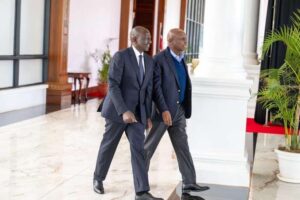
A surprise handshake between President William Ruto and Kanu Chairman Gideon Moi has ignited political tremors in the Rift Valley, with a section of Kalenjin leaders and supporters branding the move a “betrayal” that exposes deep rifts within the community’s political elite.
The leaders have held two surprise meetings — one at State House, Nairobi, and another at Kabarak — in what insiders describe as a renewed effort to mend long-standing political and personal differences between the two families. The closed-door State House meeting, reportedly attended by a few close aides, focused on reconciliation and possible collaboration ahead of the 2027 elections. Sources said Ruto extended an olive branch to Gideon, urging unity among Rift Valley leaders to “secure peace and regional stability.”
Days later, the President visited Kabarak, where he met Gideon and other family members in what was described as a “courtesy and unity call.” The visit — the first by Ruto since taking office — has stirred intense speculation within political circles, with some allies interpreting it as a calculated move to neutralize internal dissent and consolidate support in the Rift Valley. Others, however, view it as a symbolic gesture aimed at healing decades of political rivalry between the Moi and Ruto camps.
For many, the handshake symbolized the closing of an old political wound between Ruto and the Moi family, dating back to the bitter 2002 and 2013 fallouts. But among hardline supporters, especially within Ruto’s United Democratic Alliance (UDA) strongholds, the moment was met with suspicion and disapproval.
“That handshake was a stab in the back. Gideon has always opposed Ruto, and now he suddenly appears by his side? It doesn’t sit well with the people,” said Kipkemoi Ngetich, a vocal UDA youth leader in Kericho.
Others, however, hailed the gesture as a sign of political maturity and healing.
“It’s time for our leaders to put old grudges aside. The Kalenjin community stands to gain more from unity than division,” said Kanu Secretary General Nick Salat.
Political analysts say the handshake could have far-reaching implications, especially for Kanu’s positioning in the Rift Valley and the broader political realignment ahead of 2027.
“Gideon Moi’s move is both symbolic and strategic. It signals that he’s open to dialogue and political reinvention, but it also unsettles those who see him as a rival to Ruto’s dominance,” noted Dr. Jane Mbugua, a political analyst at the University of Nairobi.
The handshake also comes at a time when the Rift Valley political landscape is showing early signs of fatigue within UDA ranks, with some local leaders complaining about unfulfilled promises and limited development progress.
“Some feel left out in the government they fought so hard to build. This makes the handshake look like an elite deal rather than genuine reconciliation,” said a senior UDA official who requested anonymity.
Gideon Moi, who has kept a low political profile since the 2022 elections, described the handshake as a “moment of peace and national unity,” saying Kenya must move beyond the politics of bitterness.
“We must rise above our past differences and work together for the good of this nation,” Gideon said.
President Ruto echoed similar sentiments, emphasizing that Kenya’s progress depends on reconciliation and collective leadership.
“We cannot build the future by holding onto old grudges. This handshake is about peace, not politics,” Ruto said.
Still, within the Rift Valley’s political base, the handshake has reopened old wounds and stirred emotions that may shape the region’s political discourse for months to come.
Gideon also dropped out of the Baringo Senatorial bid after the meet up.