

By Shadrack Nyakoe
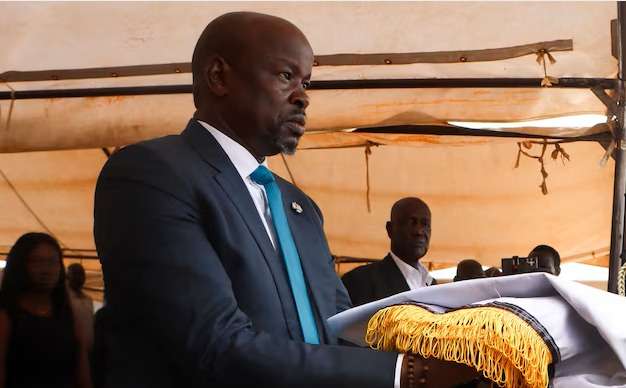
South Sudanese President Salva Kiir has abruptly dismissed his influential Vice President, Dr. Benjamin Bol Mel, in a dramatic move that signals deepening rifts within the ruling elite and could reshape the country’s fragile political landscape.
The surprise announcement came late Tuesday night through a presidential decree broadcast on the state-run South Sudan Broadcasting Corporation (SSBC). In the proclamation, President Kiir not only relieved Dr. Mel of his duties as Vice President but also stripped him of his military rank and expelled him from the National Security Service (NSS).
“Pursuant to the provisions of Section 51(4) of the National Security Service Act, 2014 (as amended), I, Salva Kiir Mayardit, President of the Republic of South Sudan and the Supreme Commander of All Regular Forces, do hereby demote Gen. Dr. Benjamin Bol Mel to the rank of Private and dismiss him from the National Security Service,” the decree read.
The move effectively ends Mel’s eight-month tenure as Vice President and marks the steepest political fall of one of South Sudan’s fastest-rising power brokers.
Dr. Mel’s dismissal was followed by a wave of sackings targeting his close associates across key government and economic institutions.
Addis Ababa Othow, Governor of the Bank of South Sudan and a longtime ally of Mel, was replaced by Yeni Samuel Costa, while Simon Akuei was removed as Commissioner General of the South Sudan Revenue Authority, paving way for William Anyuon Kuol to take over.
Within the ruling Sudan People’s Liberation Movement (SPLM), Secretary General Paul Logale was also shown the door and replaced by Akol Paul Kordit another reshuffle widely seen as consolidating Kiir’s grip on the party.
The simultaneous dismissals underscore a major political realignment in Juba, coming just days after reports surfaced that security at Mel’s residence had been reduced, fueling speculation that the Vice President was under informal house arrest.
Dr. Mel’s ouster has stunned observers, given his meteoric rise and close proximity to the president’s inner circle. At just 47, he had been viewed as Kiir’s potential successor a perception bolstered by his rapid promotions in both government and the security establishment.
Only two months ago, Mel had been elevated to the rank of full General within the Internal Bureau of the National Security Service, capping a string of swift advancements over the past year.
Appointed Vice President in February 2025 to head the government’s economic cluster replacing veteran leader Dr. James Wani Igga Mel quickly emerged as one of the most powerful figures in Kiir’s administration. His subsequent appointment in May as First Deputy Chairman of the SPLM further cemented his status as heir apparent.
But in hindsight, his September remarks thanking Kiir and First Lady Mary Ayen Mayardit for “raising and supporting me under her wing” may have hinted at growing tensions and internal rivalries within the ruling circle.
Dr. Mel’s dismissal also comes amid renewed scrutiny from the international community over South Sudan’s pervasive corruption. The former vice president has been under U.S. sanctions since 2017 for alleged embezzlement and misuse of public resources through his construction conglomerate, which American authorities accused of securing lucrative state contracts through political influence.
In recent weeks, a blistering report by the United Nations Commission on Human Rights in South Sudan (CHRSS) appeared to reignite the controversy. The report, titled “Plundering a Nation: How Rampant Corruption Unleashed a Human Rights Crisis in South Sudan,” accused Bol Mel and his associates of orchestrating systemic looting that drained billions from the public coffers.
Commissioner Barney Afako, one of the authors of the report, said the diversion of both oil and non-oil revenues had “deepened poverty and hunger across the country,” leaving critical infrastructure projects abandoned and nearly two-thirds of the population facing severe food insecurity.
According to UN estimates, more than $2.2 billion has been siphoned off-budget in recent years, aggravating a humanitarian crisis in which 8 million South Sudanese now depend on aid for survival.
While President Kiir has not provided reasons for Mel’s dismissal, political insiders say the decision may be linked to growing concerns over the Vice President’s influence and ambitions ahead of the country’s long-delayed elections.
The reshuffle has thrown the SPLM’s succession dynamics into disarray, with several senior figures now repositioning themselves in anticipation of Kiir’s next political move.
For now, Juba is abuzz with speculation not only over what triggered the sudden purge but also over who will fill the vacuum left by Mel’s departure from both government and party leadership.
What seems certain, however, is that President Kiir has reasserted his dominance within the SPLM, even as questions linger over stability, governance, and accountability in Africa’s youngest nation.