

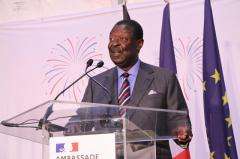
Prime Cabinet Secretary Musalia Mudavadi.[Courtesy]
Kenya says independent investigations are underway into alleged human rights violations after the United Nations raised concerns, stressing the country remains committed to freedoms of expression, assembly, and fair trial.
In a letter to the UN Office in Geneva on Tuesday, October 28, Prime Cabinet Secretary and Foreign and Diaspora Affairs Cabinet Secretary Musalia Mudavadi noted the government is constrained from commenting on individual cases to preserve judicial independence.
“The matters raised are under active investigation and adjudication by independent constitutional bodies,” said Mudavadi.
Kenya highlighted its legal framework, including the 2010 Constitution, which enshrines a robust Bill of Rights, and ratification of the International Covenant on Civil and Political Rights (ICCPR) and the African Charter on Human and Peoples’ Rights.
The government also said over 14,000 registered civil society organisations operate freely under the Public Benefit Organisations Act of May 2024, which expedites registration and grants tax benefits.
The country has faced repeated scrutiny over human rights practices during public demonstrations and activism. In 2024 and 2025, multiple protests, including the June 25 demonstrations, resulted in deaths and injuries, prompting investigations by the Independent Policing Oversight Authority (IPOA).
Civil society organisations, journalists, and activists have at times alleged excessive use of force and arbitrary arrests.
The UN communication raised questions about the arrests and charges of activists, including Mark Amiani, John Mulingwa Nzau, Francis Mutunge Mwangi, and Boniface Mwangi.
Kenya confirmed all were promptly brought to court, released on bail, and that legal proceedings are ongoing. “All actions were taken in accordance with due process,” noted Mudavadi.
The government defended the deportation of Martin Mavenjina on national security grounds, noting the decision is under appeal before the Immigration Appeals Tribunal.
Kenya also responded to reports of excessive force in protests, including the June 25 demonstrations that left 16 people dead.
The IPOA is investigating all fatalities, and a 14-member panel appointed by President William Ruto will propose reparations for victims, though the panel’s constitutionality is challenged in court.
“Victims and families have access to remedy through civil suits, public interest litigation, and the National Coroner Service Act,” added Mudavadi.
The government reaffirmed that peaceful assembly requires notification, not approval, and that police are mandated to facilitate demonstrations under strict use-of-force rules.
A High Court directive also suspended a Communications Authority order affecting media freedoms on the same day it was issued.
Kenya said it takes the UN concerns seriously and remains committed to international obligations, open governance, and democracy.